
Bible mind maps for connecting passages and observations
Put a passage’s ideas where you can see their relationships. A Bible mind map can gather references, observations, and questions around one study, with labels that explain why the connections matter.
Explore the Romans 8 example below, then use Scripture Deck to build a map of your own.

01
Explore a Romans 8 Bible study mind map
This original study map follows Romans 8:1–39 in the World English Bible. Its labels are editorial summaries of passage sections, rather than quotations or the Bible’s own section headings. The map gives you a way to revisit the chapter; each summary should be checked against its verses.
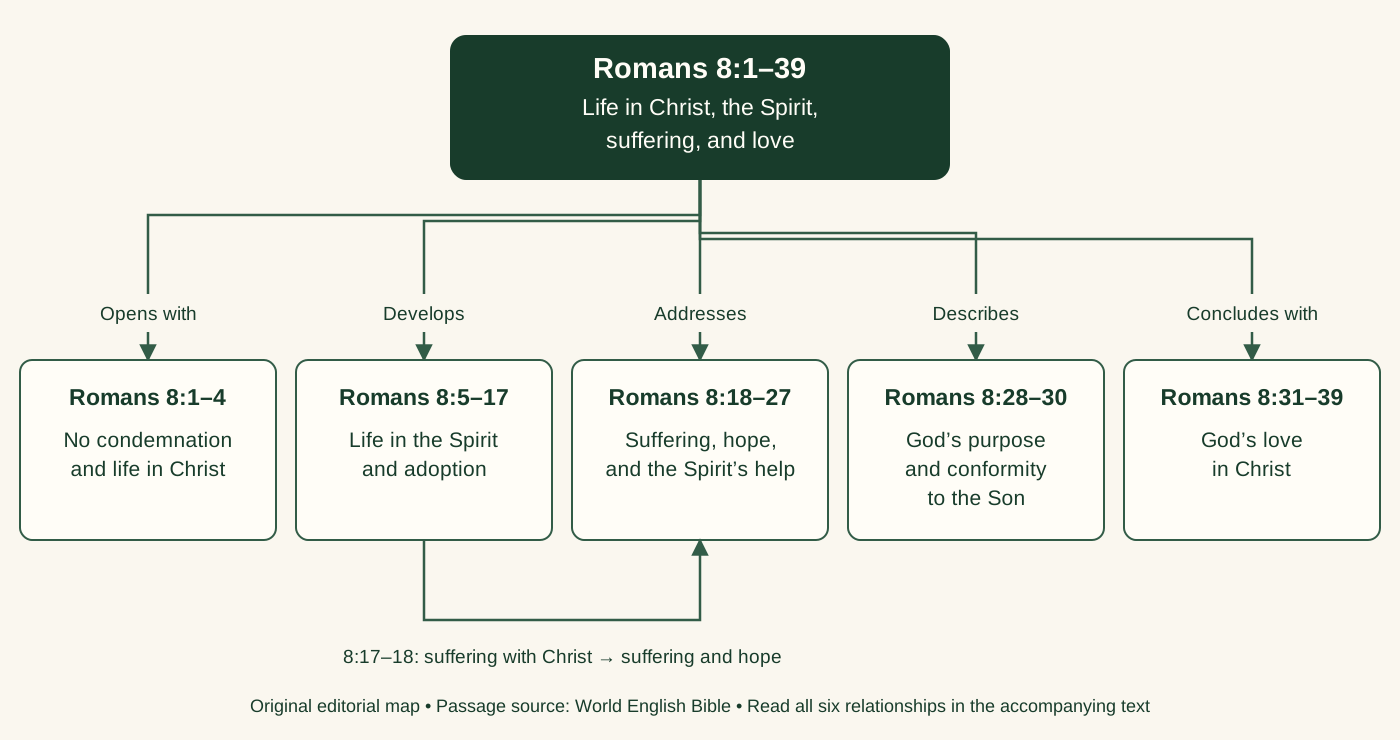
Passage scope and the map’s main connections
The central node is Romans 8:1–39 — life in Christ, the Spirit, suffering, and love. Five branches follow the chapter:
| Passage node | Editorial label | Connection from the chapter |
|---|---|---|
| Romans 8:1–4 | No condemnation and life in Christ | Opens with |
| Romans 8:5–17 | Life in the Spirit and adoption | Develops |
| Romans 8:18–27 | Suffering, hope, and the Spirit’s help | Addresses |
| Romans 8:28–30 | God’s purpose and conformity to the Son | Describes |
| Romans 8:31–39 | God’s love in Christ | Concludes with |
One additional connection links Romans 8:5–17 to Romans 8:18–27: suffering with Christ leads into the discussion of suffering and hope. Verse 17 mentions suffering with Christ and being glorified with him; verse 18 turns to present suffering and future glory.
02
Read the map’s connections as text
What each connection means and where to check it
Romans 8 opens with no condemnation and life in Christ (8:1–4). These verses connect freedom from the law of sin and death with what God has done through his Son. Read the whole opening section before treating its first sentence as a complete summary of the chapter.
Romans 8 develops life in the Spirit and adoption (8:5–17). This section contrasts the flesh and the Spirit, speaks of the Spirit dwelling in believers, and describes being led by the Spirit and receiving adoption. The branch gathers several related observations; it does not reduce every use of “Spirit” to a single definition.
Romans 8 addresses suffering, hope, and the Spirit’s help (8:18–27). The passage includes creation’s groaning, believers waiting, and the Spirit helping in weakness and interceding. Those subjects share a branch because they appear together in this section, rather than because a diagram proves they are interchangeable.
Romans 8 describes God’s purpose and conformity to the Son (8:28–30). Verse 28 speaks of those called according to God’s purpose; verse 29 speaks of being conformed to the image of his Son. Study question: What does reading these statements together add to your understanding of “good” in verse 28? Keep questions about foreknowledge and predestination for further study.
Romans 8 concludes with God’s love in Christ (8:31–39). The closing questions concern opposition, accusation, condemnation, and separation from Christ’s love. Verses 38–39 bring the section to its statement about God’s love in Christ Jesus.
Suffering with Christ connects the second and third branches (8:17–18). This is a connection across adjacent verses. It helps explain why the map moves from adoption and inheritance to suffering and hope.
These six connections are the complete relationship list shown in the diagram. Read Romans 8:1–39 in your Bible to check each one.
03
Build a map from a passage
- Read the passage before deciding its main nodes. Begin with a chapter, a short scene, or a question with a clear reference.
- Create a mind map in Scripture Deck and give it a title that identifies the study.
- Add the passage from the reader to your chosen map. Add topic, question, or interpretation nodes for your own observations.
- Connect the nodes and label the relationship. “Contrasts with,” “raises the question,” or “repeats this theme” says more than an unlabeled line.
- Move the nodes into a layout you can follow. Reopen the linked passages and revise any connection that overstates the evidence. Choose Save map to keep your changes.
You can add, edit, duplicate, and remove nodes as the study changes. Saved positions and labeled connections keep the map usable when you return.

04
Return from each connection to Scripture
A Scripture node keeps a link to its passage. Open that passage to check the wording and surrounding verses; verse details also identify maps that contain the verse.
Use a reference for the evidence and a separate label for your interpretation. If a connection remains uncertain, make it a question. That keeps your map useful without making an unfinished idea look settled.
Keep your study observations in a note, or begin with a manageable Bible passage.
05
Mind maps and verse mapping
A mind map arranges ideas and their relationships across a visual canvas. You might use it for one chapter, a repeated theme, or a set of questions.
A verse-mapping worksheet usually works closely through a selected verse, recording context, wording, related references, and application. You can use both approaches in a study: examine the verse carefully, then decide which connections belong on a broader map.
Scripture Deck’s mind maps provide nodes, labeled connections, and passage links. They do not supply a completed language-study worksheet for every verse.
Questions
Bible mind-map questions
Do I have to start with a whole chapter?
No. Start with the passage or question you can work through. A map with three well-explained nodes can be more useful to revisit than a crowded map with unclear connections.
Can I open the Bible passage from a node?
Yes. Scripture nodes retain their passage references so you can return to the reader and check context.
Can I use the Romans 8 example before creating an account?
You can study the example and its complete text explanation on this page. To create and save your own map in the app, you need an account. The example is an editorial diagram, not an automatic map import.
What should I do with a connection I am unsure about?
Label it as a question and record the verses that prompted it. Revisit the context or a source you can identify before turning it into a conclusion.
Sources: Romans 8:1–39, World English Bible, is the primary text for the map and its explanations. See the World English Bible publisher. The diagram and relationship labels are original editorial material prepared for Scripture Deck.